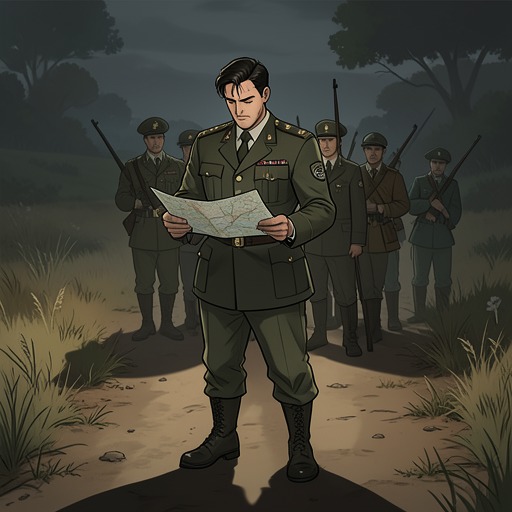
Shinjuku Rashomon Murder Incident
The Narrow Road to the Deep NorthThe Shinjuku Rashomon Murder Incident is a postwar episode in which Tenji Nakamura, living amid Tokyo’s ruins and fearing arrest as a possible war criminal, comes upon a dead American serviceman and a young Japanese boy in a bomb-damaged room. The encounter reveals how hunger and self-preservation govern Nakamura’s choices, and becomes the beginning of his flight under a false identity.
Background and Discovery
After Japan’s surrender, Nakamura survives by scavenging and selling timber from the wreckage of Tokyo. A newspaper report about warrants for former POW-camp staff names him as a possible Class B war criminal. He believes the Americans are closing in, and his fear of being captured and executed shapes his immediate concern: finding a way to survive. While sheltering near the ruined Shinjuku Rashomon, he hears muffled shouting and a woman’s hiss. Curiosity draws him from his hiding place and toward an opening in the rubble.
Through a small hole, Nakamura sees a young woman and a boy of about sixteen or seventeen in a damaged room. The uniformed body of an American serviceman lies nearby. The woman is angry with the boy for killing the American; Nakamura, concealed from them, takes in the scene but is chiefly drawn to two gyoza dumplings and a bar of chocolate on a makeshift table. The food recalls his service in Manchukuo, when gyoza had been an ordinary meal, and hunger narrows his attention to the chance of obtaining it.
The Confrontation and Its Cover Story
Unable to think past his hunger, Tenji Nakamura enters the damaged room through the opening in the wall, carrying his crowbar. The boy charges him with a knife, and Tenji Nakamura strikes him with the crowbar; the boy dies. The woman falls silent, then begins to whimper. Tenji Nakamura takes the two gyoza dumplings from the table and eats them while watching her. The contrast is stark: two deaths have occurred, but his immediate attention remains fixed on food and on the danger the scene poses to a man already sought by the authorities.
Tenji Nakamura tries to make the American serviceman’s death appear to have resulted from a struggle with a thief. He positions his crowbar in the dead man’s hand and drops it into the blood on the floor, intending to suggest that the weapon belonged to the serviceman. The woman attempts to stop Tenji Nakamura from leaving and says that the American had assaulted her and that her brother had intervened to protect her. Tenji Nakamura does not investigate her account; concerned that she might identify him, he threatens her into silence and leaves the Shinjuku Rashomon. His actions turn the encounter into another secret to escape rather than a matter of responsibility or justice.
Flight, Impunity, and the Incident’s Wider Frame
The killing does not end with Tenji Nakamura’s departure from the ruined archway. He uses fifty American dollars taken from the woman to obtain false identity papers, and sells her clothes to another woman in order to buy a train ticket to Kobe. In a third-class carriage with its windows blown out, he leaves Tokyo under a new name, Yoshio Kimura, abandoning the identity of a former railway-regiment major for that of a former private. The altered identity gives him a means to disappear, not security: in Kobe he continues petty theft and black-market dealing, and fear of recognition by a former Australian officer from a POW camp keeps him indoors at night for a week.
The incident therefore makes flight a practical continuation of the killing and its cover-up. Tenji Nakamura does not seek help or report what happened; he leaves behind a scene he has tried to arrange to implicate the dead American, while the woman’s account and fate remain unresolved in the evidence. His new papers and journey carry him away from the immediate danger, but the fear that authorities may find him persists. The episode also places his private evasion beside the postwar pursuit of former camp staff: a newspaper has already listed him as a possible Class B war criminal, and he follows the trials closely after reaching Kobe.
That larger context gives the murder an uneasy place within the novel’s treatment of postwar accountability. Tenji Nakamura reads of a Japanese soldier convicted and hanged for beating an escaped POW, but finds the outcome difficult to comprehend. Elsewhere, the account of Choi Sang-min’s Australian military trial shows how contradictory written testimony and incomplete camp records shape a conviction, while Choi believes that officers such as Colonel Kota have escaped consequences. The novel also records that Professor Ishiyama died in prison, while other defendants had death sentences commuted and were released; Sato says that both the Americans and the Japanese want the matter forgotten. Against this uneven landscape of prosecution, release, and concealment, Tenji Nakamura’s escape after the Shinjuku killing is not presented as justice achieved but as another instance in which survival and impunity become entangled.
The wider memorial frame sharpens that contrast. At the Yasukuni Shrine in Tokyo, steam locomotive C 5631 is displayed beside the Book of Souls, which includes the names of more than a million men convicted of war crimes after the war, including some found guilty of mistreating POWs. The plaque before the locomotive omits the railway’s horrors and the names of its dead; the number of Asian forced laborers who died is unknown, and their names have been forgotten. The Rashomon episode operates on a smaller, immediate scale, but it shares this concern with what survives as a record and what vanishes: Tenji Nakamura reshapes the evidence of two deaths to protect himself, while the novel sets that personal concealment against the larger postwar struggle over responsibility and remembrance.
Forgetting and the Public Record
The incident’s private concealment belongs to a wider struggle over how postwar responsibility is recorded. At Yasukuni Shrine in Tokyo, the Book of Souls lists more than two million people who died in service to the Emperor between 1867 and 1951; among them are 1,068 men convicted of war crimes after the Second World War and executed, including men found guilty of mistreating POWs. Enshrinement at the shrine carries an idea of absolution, even as the railway locomotive displayed there commemorates no victims on its plaque. The contrast is not simply between remembering and forgetting: names can be preserved within a memorial that also obscures the violence those names are connected to.
Against that institutional setting, Tenji Nakamura’s manipulation of the evidence in the ruined room becomes a sharply limited, personal version of the same contest over what will count as the truth. He tries to make the dead American appear responsible for the deaths, while the woman’s explanation is left without investigation and her later fate is not supplied. The novel places this small act of evasion beside a record in which the railway’s dead have no complete count and many have no names preserved. It does not equate Nakamura’s immediate self-protection with the public memorial’s politics; rather, it shows how easily responsibility can be displaced when the vulnerable have little power to make their account endure.